Luxury hospitality: a flagship hotel investment proposal
A 15-slide investment committee proposal for a fictional palace hotel in Lisbon: architectural concept illustrations and photographs, the market, a ramp-up table, the €145m budget, financing, the operating projection, scenario returns and sensitivities as native charts, milestones and three decisions. Illustrative financials.
A four-page fictional brief (Markdown) from the developer's team: the palace and concept, the Lisbon market, positioning and ramp-up, the budget, financing, the operating projection, returns with scenarios and sensitivities, milestones and risks.
With these instructionsAn investment committee proposal from the Calder & Wren Property Partners development team: write in the presenters' voice, making the case and asking for approval, not as an outside reviewer questioning the brief. Lead with the architecture and the concept: use photographs of palace architecture, heritage interiors, Lisbon and luxury hospitality, and illustrations of the restored spaces where no photograph can show them. Cover the opportunity, the concept, the market, positioning and ramp-up, the development budget, financing, projected operations, returns and scenarios, milestones and risks, ending with the decisions requested. Show the budget, the ramp-up, the operating projection and the scenario returns as native, editable charts or tables. All names and figures are fictional: label data slides Illustrative financials, and write source lines as 'Source: Calder & Wren development team underwriting, November 2026 (illustrative)' or the source named in the brief, never 'the brief'. Speaker notes should explain the assumptions behind each number and what the committee is being asked to accept.
Free to download, no sign-in needed. Open it in PowerPoint and change anything.

- Look
- Photo Editorial
- Deck type
- Investor Pitch
- Images
- Rich visuals
- Slides
- 15
- Deck language
- English
Every slide, unedited
Click a slide to see it large.
-
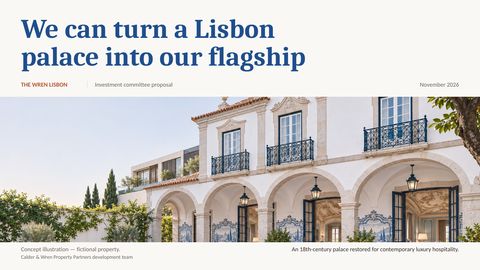
1We can turn a Lisbon palace into our flagship
Speaker notes
Today we are asking the committee to back an architecture-led flagship: restoring an 18th-century Lisbon palace rather than developing a hotel that could be anywhere. The investment case brings together the building’s heritage, a luxury operating plan and a conditional acquisition within a €145 million development budget; the property and financials are fictional and presented for illustration.
-
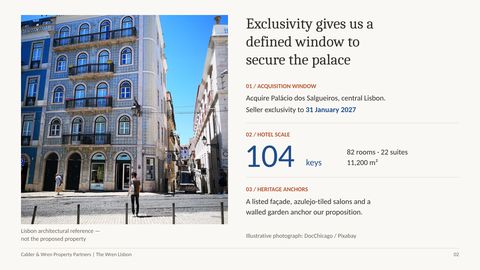
2Exclusivity gives us a defined window to secure the palace
Speaker notes
That architectural proposition comes with a defined acquisition window: seller exclusivity runs until 31 January 2027. The palace provides 11,200 square meters for a proposed 104-key hotel, including 22 suites, but its distinguishing assets are the listed façade, tiled salons and walled garden. Those features underpin the investment thesis, which is why securing the property must remain conditional on heritage pre-approval rather than simply meeting the seller’s deadline.
-
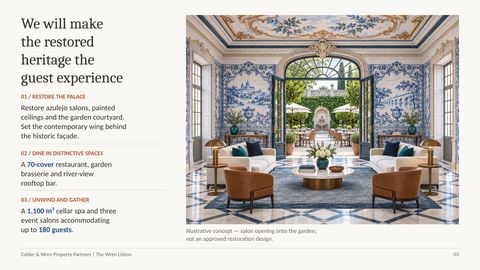
3We will make the restored heritage the guest experience
Speaker notes
Those heritage assets need to become part of the stay, not just a backdrop to it. The concept restores the salons, painted ceilings and courtyard while placing the contemporary wing behind the historic façade. Dining extends from the garden to the rooftop, while the vaulted cellars accommodate the spa and three salons support weddings and private dinners for up to 180 guests. These uses connect preservation with the operating plan, although the concept is not yet an approved restoration design.
-
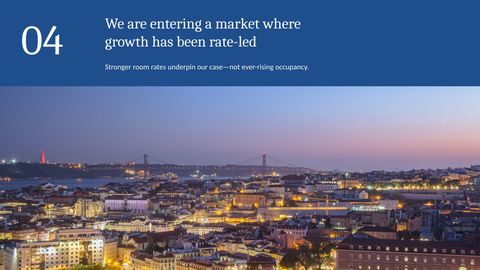
4We are entering a market where growth has been rate-led
Speaker notes
With that guest experience defined, the next question is whether Lisbon’s market supports the positioning. The evidence points to growth driven by room rates rather than higher occupancy, an important distinction for our underwriting.
-
5Luxury rates have risen while occupancy remains below 2019
Speaker notes
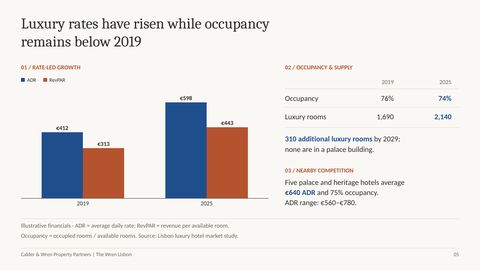
That rate-led pattern is clear in the market inputs: average daily rate rose from €412 in 2019 to €598 in 2025, taking revenue per available room from €313 to €443. Occupancy, however, was 74% in 2025 against 76% in 2019, while luxury supply increased from 1,690 to 2,140 rooms. Another 310 rooms are expected by 2029, so we should not treat rate growth as evidence of an unconstrained market. None of that pipeline is in a palace building, but five nearby palace and heritage hotels already compete at an average rate of €640 and 75% occupancy.
-
6Our rate assumption does not require a top-tier palace premium
Speaker notes
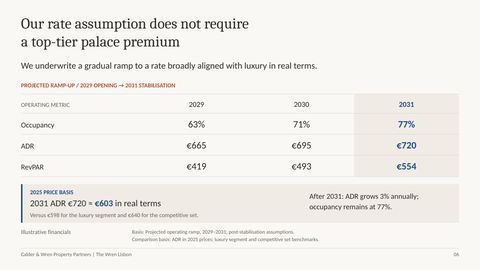
Against those benchmarks, our rate assumption does not depend on outperforming the best palace hotels. The projected €720 daily rate at stabilisation in 2031 is about €603 in 2025 prices, close to the segment’s €598 and below the heritage competitive set’s €640. We allow occupancy to build from 63% at opening to 77% at stabilisation, so the plan still requires occupancy above the current market benchmarks. Thereafter, occupancy stays flat and daily rates grow by 3% annually rather than assuming continued occupancy gains.
-
7Our capital will restore the palace and create its earning spaces
Speaker notes
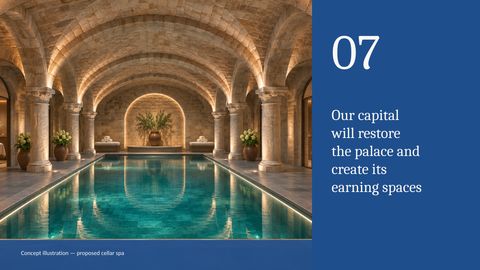
Delivering that operating ramp requires investment in both the historic fabric and the spaces that generate revenue. The capital plan therefore needs to be judged as a restoration programme and a hospitality development together.
-
8We seek a €145.0m envelope with explicit cost protection
Speaker notes
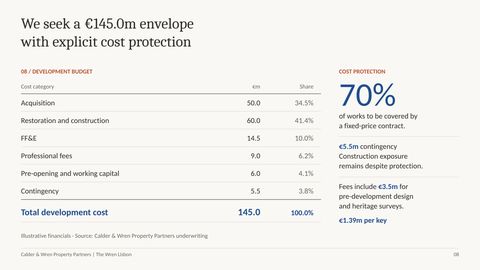
That combined programme requires €145 million, with €50 million for acquisition and €60 million for restoration and construction forming the largest commitments. The balance funds fit-out, professional work, opening liquidity and a €5.5 million contingency. We plan to fix pricing on 70% of the works, but that is a planned protection, not the elimination of construction exposure. The €3.5 million requested for early design and heritage surveys is already included within professional fees, not additional to the budget.
-
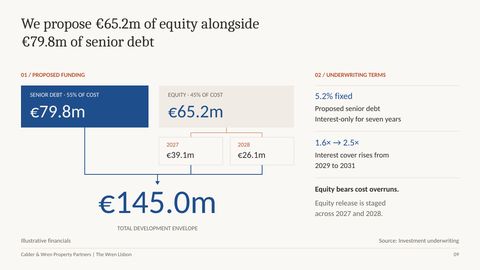
9We propose €65.2m of equity alongside €79.8m of senior debt
Speaker notes
The remaining construction exposure matters directly to the funding decision because equity will fund overruns. The proposed structure pairs €65.2 million of equity with €79.8 million of senior debt, with equity called in 2027 and 2028 to support delivery. Debt is underwritten at a fixed 5.2%, interest-only for seven years, while projected interest cover improves from 1.6 times at opening to 2.5 times at stabilisation. That makes the early operating ramp the tighter period for debt-service coverage.
-
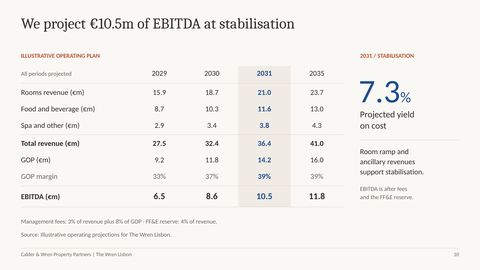
10We project €10.5m of EBITDA at stabilisation
Speaker notes
That improvement in coverage depends on translating the room ramp and ancillary facilities into earnings. Total revenue is projected to rise from €27.5 million at opening to €36.4 million in 2031, including €11.6 million from food and beverage and €3.8 million from spa and other activities. Over the same period, the gross operating margin rises from 33% to 39%, supporting €10.5 million of stabilised EBITDA and a 7.3% yield on cost. That EBITDA is after management fees and a 4% revenue reserve for furniture, fixtures and equipment, rather than before those deductions.
-
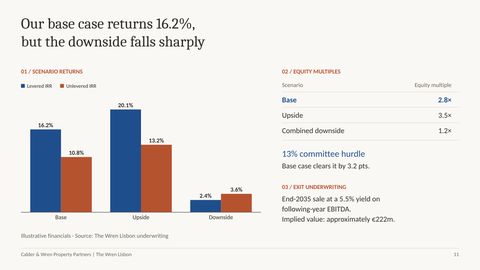
11Our base case returns 16.2%, but the downside falls sharply
Speaker notes
Those operating earnings support a base-case levered return of 16.2%, above the committee’s 13% hurdle, with a 2.8-times equity multiple. The result also depends on an end-2035 sale at a 5.5% yield on the following year’s EBITDA, implying approximately €222 million of value. The combined downside brings together weaker rates and occupancy, higher costs and a wider exit yield, reducing the levered return to 2.4% and the equity multiple to 1.2 times. Its unlevered return is 3.6%, compared with 10.8% in the base case, underscoring that leverage does not protect equity when those pressures coincide.
-
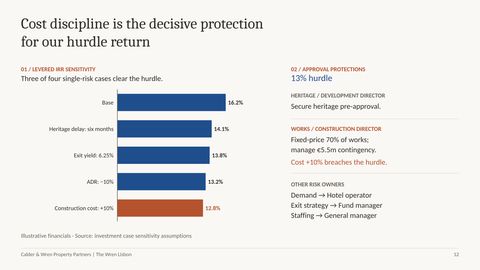
12Cost discipline is the decisive protection for our hurdle return
Speaker notes
That combined downside makes it important to isolate which individual risks can break the hurdle. A 10% construction cost increase takes the levered return to 12.8%, whereas a six-month heritage delay leaves 14.1%, a wider exit yield leaves 13.8%, and a 10% rate reduction leaves only 13.2%. Cost control is therefore central to approval, with the construction director responsible for planned fixed pricing on 70% of works and management of the contingency. The development director owns heritage pre-approval, while the operator, fund manager and general manager own demand, exit and staffing mitigations respectively.
-
13We will stage delivery from heritage approval to a 2029 opening
Speaker notes
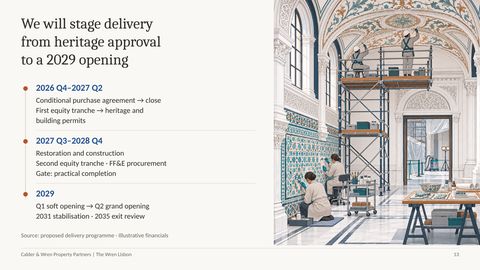
Those responsibilities need to be embedded in the delivery sequence, beginning with a purchase agreement conditional on heritage pre-approval. The indicative programme places acquisition close and the first equity tranche in the first quarter of 2027, followed by heritage and building permits in the second quarter. Construction starts in the third quarter, with the second equity tranche and fit-out procurement supporting practical completion in late 2028. Soft opening is planned for early 2029, followed by the grand opening in the second quarter; stabilisation is targeted for 2031, with a sale-or-hold review in 2035.
-
14We recommend proceeding with heritage protection built in
Speaker notes
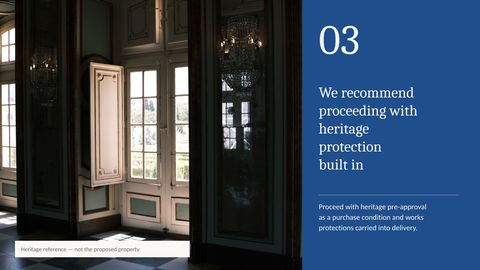
With that sequence and those risk owners established, we recommend proceeding conditionally rather than treating heritage consent and cost protection as matters to resolve later. The purchase condition protects the architectural thesis, while the planned works protections address the single risk that takes returns below the hurdle.
-
15Approve the acquisition, funding and pre-development release
Speaker notes
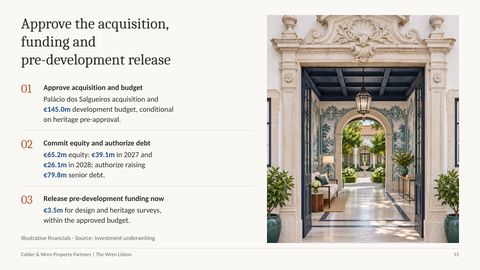
To put that recommendation into effect, we are seeking three approvals: the acquisition and €145 million development budget subject to heritage pre-approval; €65.2 million of equity and authority to raise €79.8 million of senior debt; and an immediate €3.5 million release for design and heritage surveys within the budget. The equity commitment would be staged as €39.1 million in 2027 and €26.1 million in 2028. Our recommendation is to approve on that conditional basis, advancing the flagship opportunity while making heritage protection and construction discipline central to delivery.


What you can change in the file
Every word is real text
Titles, bullets and labels are text boxes. Retype them, restyle them or translate them.
Diagrams are shapes
Boxes, arrows and icons are PowerPoint shapes you can move, resize and recolour.
Pictures stay separate
Photos and illustrations are their own images, so you can swap or crop them.
Charts are real charts
Each chart keeps its numbers in its own Excel sheet. Choose Edit Data, type new figures and the chart redraws.
 How to make slides or a PowerPoint automatically
 Quarterly business review: performance, drivers and decisions
 AlphaFold 3: a research briefing for biopharma R&D leaders
Make your next deck in minutes, then make it yours.
Start with 20 free credits. No card needed.
Start free