AlphaFold 3: a research briefing for biopharma R&D leaders
Sixteen slides from the open-access Nature paper (Abramson et al., Nature 630, 493–500, 2024, CC BY 4.0): an editable diagram of the model, native charts rebuilt from the paper's Extended Data Table 1 with confidence intervals, the paper's own figures with credits, the limitations that matter and a pilot plan with validation gates.
The paper's PDF (24 pages), plus a text copy of its Extended Data Table 1, because the PDF draws that table as vector art with no readable numbers. Open the original
With these instructionsA research briefing for biopharma R&D leaders, built from this paper. Turn it into an executive narrative: the problem, the approach, the key results, the limitations and the implications for R&D. Use the paper's figures and credit each one (Abramson et al., Nature 630, 493–500 (2024), CC BY 4.0). Explain the approach with an editable diagram, and rebuild headline quantitative results as native charts using only the numbers in Extended Data Table 1 (repeated as text in the second source; cite it as Extended Data Table 1 and never mention a transcription): ligand docking on PoseBusters, protein–nucleic acid interfaces, and protein–protein and antibody complexes against AlphaFold-Multimer. Speaker notes should be substantive: what each result means and what to ask next.
Free to download, no sign-in needed. Open it in PowerPoint and change anything.

- Look
- Blueprintchosen automatically
- Deck type
- Academic Research
- Images
- Document figures only
- Slides
- 16
- Deck language
- English
Every slide, unedited
Click a slide to see it large.
-

1AlphaFold 3: Evidence and Implications for Biopharma R&D
Speaker notes
Today we’ll examine what AlphaFold 3 establishes about predicting biomolecular complexes, and where that evidence stops short of an R&D decision. The central question is not simply whether its structures are more accurate, but whether those improvements support useful, experimentally testable hypotheses under our actual working conditions. We’ll separate the architecture and benchmark evidence from the validation needed before deployment.
-
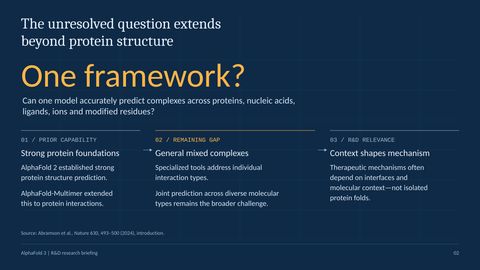
2The unresolved question extends beyond protein structure
Speaker notes
That distinction matters because the scientific problem extends beyond predicting an isolated protein fold. AlphaFold 2 and AlphaFold-Multimer established strong capabilities for proteins and their interactions, but mixed complexes require a framework that also accommodates nucleic acids, small molecules, ions, and modified residues. For discovery teams, the value lies in modeling the molecular context and interfaces on which therapeutic mechanisms often depend.
-
3A unified model must represent chemistry beyond amino acids
Speaker notes
Addressing that broader molecular context requires more than adding new inputs to a protein-specific model. AF3 changes both its internal representation and the machinery that generates structures, allowing diverse chemical entities to be modeled together as atomic coordinates.
-
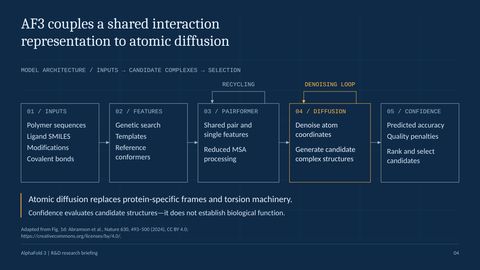
4AF3 couples a shared interaction representation to atomic diffusion
Speaker notes
Those changes preserve a separation between reasoning about interactions and generating a physical structure. Molecular inputs, search-derived features, templates, and reference conformers feed a shared representation, while the pairformer concentrates processing on pair and single features rather than retaining extensive MSA processing. A diffusion module then iteratively denoises atomic coordinates to produce candidate complexes. Confidence estimates and quality penalties help select among those candidates, but that selection concerns predicted structural accuracy, not biological function.
-
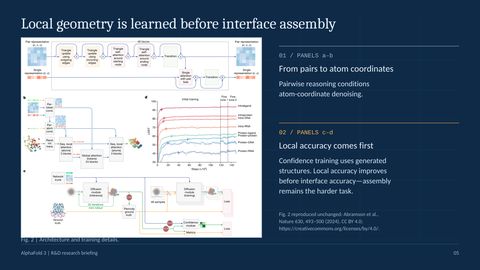
5Local geometry and interface assembly are learned on different timescales
Speaker notes
That separation between interaction reasoning and coordinate generation also helps explain the training behavior. Local structural accuracy improves before interface accuracy, so learning plausible geometry within a molecule does not immediately solve how multiple partners assemble. The confidence component is trained using generated structures, linking its predictions to the kinds of errors the model actually makes. For users, the important implication is that a convincing local fold cannot substitute for checking the interface.
-
6Benchmark conditions determine what each gain means
Speaker notes
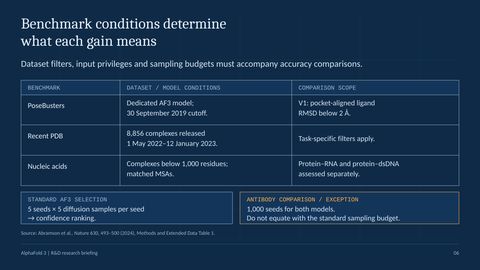
Before interpreting interface or pose accuracy, we need to establish the conditions under which it was measured. The PoseBusters evaluation uses a dedicated model with a September 2019 training cutoff, while the recent-PDB evaluation draws on 8,856 complexes with task-specific filters. Standard AF3 selection ranks candidates from five seeds with five diffusion samples per seed; antibody evaluation instead uses 1,000 seeds for both models. Input information, dataset filtering, and sampling budget therefore belong alongside any reported gain, rather than being treated as implementation details.
-
7Accuracy must be judged separately for each interaction class
Speaker notes
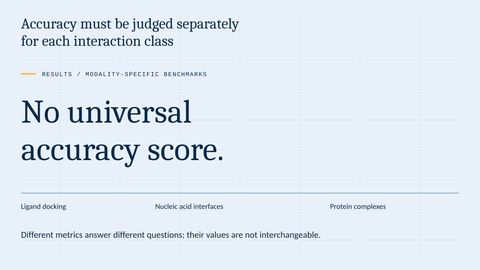
With those comparison boundaries in place, we can assess the results by interaction class. Ligand pose recovery, nucleic acid interface accuracy, and protein interface success measure different things, so none should be interpreted as a universal AF3 accuracy rate.
-
8AF3 improves blind docking, but input privileges change the comparison
Speaker notes
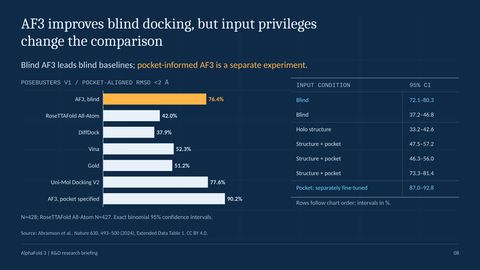
Starting with ligand poses, AF3’s blind prediction result is strong even against several methods given structural information. It reaches 76.4 percent success, compared with 42 percent for blind RoseTTAFold All-Atom and 52.3 percent for Vina with structure and pocket information, using a pocket-aligned ligand RMSD threshold below two angstroms. Uni-Mol Docking V2, also given structure and pocket information, reaches 77.6 percent, so blind AF3 does not lead every listed method. A separately fine-tuned AF3 model given pocket information reaches 90.2 percent; that is a different input condition, not an improvement that can be attributed to the blind workflow.
-
9AF3 raises protein–nucleic acid interface accuracy on both subsets
Speaker notes
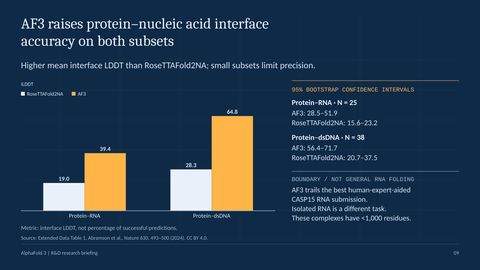
Beyond ligand docking, AF3 also improves the reported protein–nucleic acid interfaces, but here the outcome is a mean accuracy score rather than a success percentage. Mean interface LDDT rises from 19.0 to 39.4 for protein–RNA and from 28.3 to 64.8 for protein–double-stranded DNA relative to RoseTTAFold2NA. These comparisons use matched MSAs and complexes below 1,000 residues, with only 25 RNA and 38 DNA structures, so the uncertainty remains substantial. The claim also should not be extended to isolated RNA prediction, where AF3 trails the best human-expert-aided CASP15 submission.
-
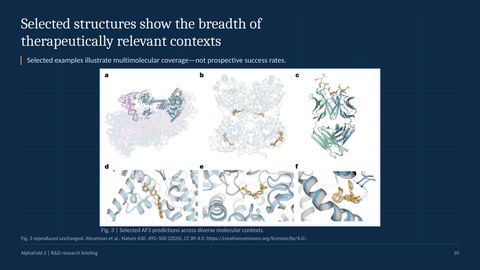
10Selected structures show the breadth of therapeutically relevant contexts
Speaker notes
Those modality-specific results establish measured gains, while selected complex predictions illustrate the breadth of molecular context the framework can accommodate. Their role is to demonstrate coverage across multimolecular systems, not to estimate how often a new internal target will succeed. For portfolio planning, that breadth supports considering a wider range of applications, while leaving prospective reliability to be established separately.
-
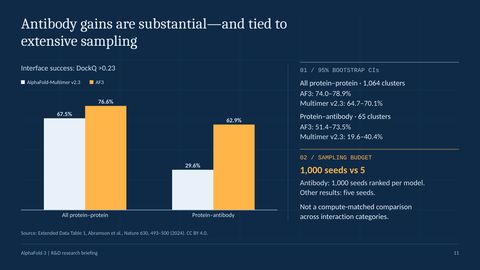
11Antibody gains are substantial—and tied to extensive sampling
Speaker notes
Moving from breadth to another quantified application, the antibody results provide a particularly strong gain with an important compute qualification. AF3 achieves 62.9 percent interface success versus 29.6 percent for AlphaFold-Multimer on 65 protein–antibody clusters, using a DockQ threshold above 0.23. Across all protein–protein clusters, the corresponding results are 76.6 and 67.5 percent. Both models receive 1,000 seeds for the antibody comparison, so the within-category gain is meaningful, but it does not establish antibody performance at the standard five-seed budget. The practical question is whether that ranked search remains useful within the team’s compute constraints.
-
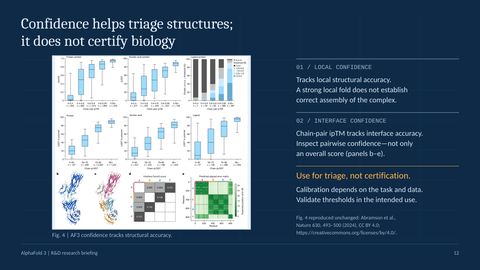
12Confidence helps triage structures; it does not certify biology
Speaker notes
Because these results depend on ranking candidate structures, confidence is part of the workflow that needs evaluation, not just a number attached to the output. AF3 confidence measures track structural accuracy, but local confidence and interface confidence answer different questions. A partner can be well modeled locally yet incorrectly positioned relative to another partner, making chain-pair ipTM important to inspect. Thresholds should be validated for the intended task and dataset, and none should be interpreted as certification of binding or activity.
-
13Structural accuracy is not yet decision validity
Speaker notes
That limit on confidence captures the broader boundary between reconstructing a structure and validating a discovery decision. A predicted pose is a hypothesis about molecular arrangement, not evidence by itself that the molecules bind, produce the intended activity, or occupy the relevant solution state.
-
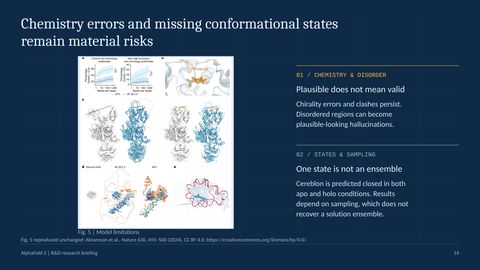
14Chemistry errors and missing conformational states remain material risks
Speaker notes
The boundary is reinforced by failures that can remain even when a prediction looks chemically plausible. The paper reports a 4.4 percent chirality violation rate on PoseBusters despite a chirality penalty in ranking, as well as occasional atomic clashes. Diffusion can also generate plausible-looking structure in disordered regions, although cross-distillation reduces that behavior. For conformational state, cereblon is a concrete warning: AF3 predicts the closed state in both apo and holo conditions, rather than recovering the observed distinction. Generating more candidates therefore should not be equated with sampling a solution ensemble.
-
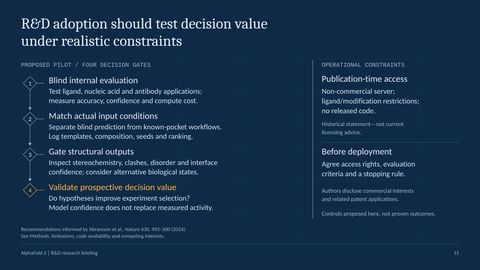
15R&D adoption should test decision value under realistic constraints
Speaker notes
Those limitations argue for a controlled pilot that tests decision value rather than merely reproducing headline accuracy. I recommend blinded internal targets across the intended applications, with actual input privileges, templates, composition, sampling, and ranking recorded so the workflow is interpretable. Structural quality checks should cover stereochemistry, clashes, disorder, interfaces, and alternative biological states, followed by prospective tests of whether the hypotheses improve experiment selection. Access rights and compute limits also need agreement before deployment; the paper’s non-commercial server and code-availability statements describe publication-time conditions, not current licensing advice. These are proposed adoption controls, not outcomes the paper demonstrated, and accountable owners should agree on evaluation criteria and a stopping rule.
-
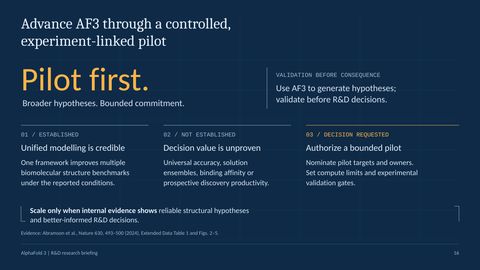
16Advance AF3 through a controlled, experiment-linked pilot
Speaker notes
The decision, then, is a qualified yes to an experiment-linked pilot, not unrestricted reliance on predicted structures. AF3 establishes broader capability and stronger benchmark performance across multiple molecular classes, but it does not establish binding affinity, solution ensembles, or prospective discovery productivity. Authorize nominated targets, accountable owners, compute limits, and experimental validation gates, and scale only when internal evidence shows that the resulting hypotheses lead to better-informed R&D decisions.


What you can change in the file
Every word is real text
Titles, bullets and labels are text boxes. Retype them, restyle them or translate them.
Diagrams are shapes
Boxes, arrows and icons are PowerPoint shapes you can move, resize and recolour.
Pictures stay separate
Photos and illustrations are their own images, so you can swap or crop them.
Charts are real charts
Each chart keeps its numbers in its own Excel sheet. Choose Edit Data, type new figures and the chart redraws.
 How to make slides or a PowerPoint automatically
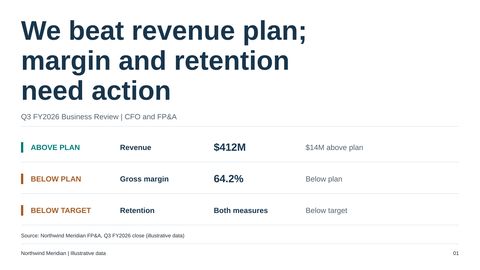 Quarterly business review: performance, drivers and decisions
 Luxury hospitality: a flagship hotel investment proposal
Make your next deck in minutes, then make it yours.
Start with 20 free credits. No card needed.
Start free