Indie game: six months after launch
An honest postmortem for a game developers' meetup, made from the team's notes and a monthly sales CSV: the demo that built the launch, sales by month as a native chart with the sale and update marked, gross to net to cost, what went right and wrong, five lessons, and a talk script split between the two developers. Pixel-art illustrations. Fictional studio, game and data.
The developers' postmortem notes (Markdown) and monthly Steam sales (CSV). Fictional studio, game and figures.
With these instructionsA meetup talk at Millbrook Game Makers on 21 November 2026 by Ines Duarte and Tom Achebe of Two Lantern Games: an honest postmortem of Moss Knight six months after launch. Write in their voice, friendly and candid, for other indie developers. Cover the game, the road to launch (the Next Fest demo), sales month by month (a native, editable chart from the CSV, marking the summer sale and the 1.1 update), the money (gross to net, and what the game cost), players and reviews, what went right, what went wrong, five lessons for small teams, and what's next. Illustrations in pixel art: a small knight made of moss, a dying forest growing back, a glowing grove, a handheld games console with no logo; no text in the pictures. All names and figures are fictional: label data slides Illustrative data, with source lines 'Source: Two Lantern Games Steam sales reports to 31 October 2026 (illustrative)'. Speaker notes should be the talk script, split between Ines and Tom.
Free to download, no sign-in needed. Open it in PowerPoint and change anything.

- Look
- Pixel Art
- Deck type
- Narrative Keynote
- Images
- AI illustrations
- Slides
- 12
- Deck language
- English
Every slide, unedited
Click a slide to see it large.
-
1Moss Knight: Six Months After Launch
Speaker notes
Ines: Hi, Millbrook Game Makers—we’re Ines Duarte and Tom Achebe, and tonight we want to talk about what finishing a small game actually left us with, not just what it took to get it out the door. Tom: This is an illustrative postmortem: all the names and figures are fictional, but the question we’re exploring is practical—how do you ship something small and still have a way to keep making games?
-
2We made a small game about growing things back
Speaker notes
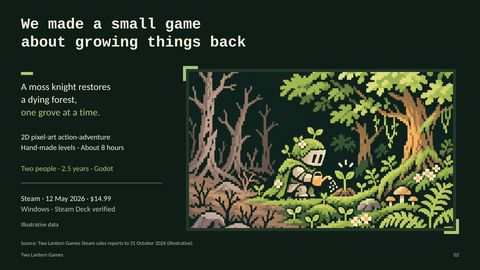
Ines: To understand what we were left with, it helps to know what we were trying to make: an adventure where your progress means bringing a forest back to life. The regrowth was the heart of it, and hand-made levels gave us a deliberately bounded game of about eight hours, rather than something endlessly expandable. I handled art and design, Tom handled code and audio, and the two of us spent two and a half years building it in Godot. We launched on Steam on May 12 at $14.99, for Windows and with Steam Deck verification.
-
3The short demo did our biggest launch-building job
Speaker notes
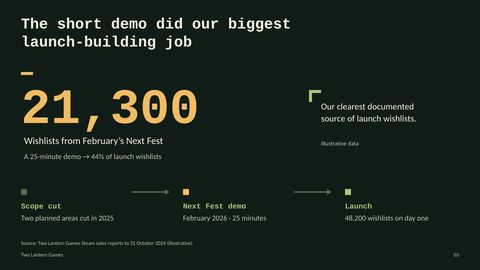
Ines: Keeping that adventure bounded also helped us get a playable piece of it in front of people. We cut two planned areas in 2025, then brought a 25-minute demo to February’s Next Fest. That week brought 21,300 wishlists—44% of the 48,200 we had at launch—making it our clearest documented source of launch interest. That’s not a promise that wishlists become sales; it’s evidence that a short demo did a substantial discovery job for us.
-
4Launch was not the finish line
Speaker notes
Tom: That launch interest got us to release, but release changed the job rather than ending it. We now had players depending on the game to work, and our plan hadn’t made enough room for that responsibility.
-
5September lifted sales—but it changed several things
Speaker notes
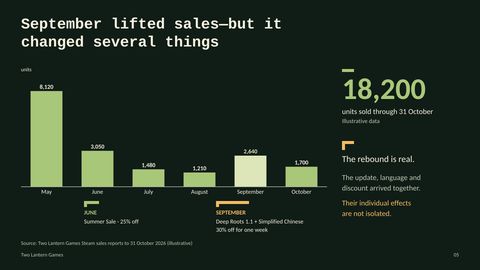
Tom: The sales history gives some context for the months when we were learning that lesson; these figures run through October 31. May brought 8,120 units, June brought 3,050 around the 25% Summer Sale discount, and then July and August fell to 1,480 and 1,210. September rebounded to 2,640, more than double August, when Deep Roots added a new area, boss rush and Simplified Chinese alongside a week at 30% off. October settled at 1,700, taking us to 18,200 units overall. The rebound matters, but because the update, language and discount arrived together, we can’t honestly assign the lift to any one of them.
-
6After costs, we were about $8,600 ahead
Speaker notes
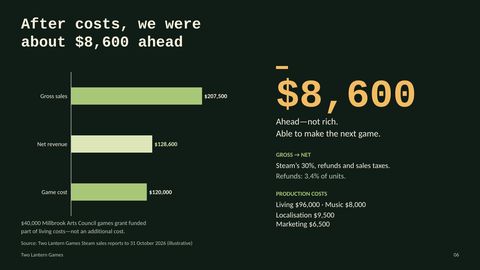
Tom: Those sales gave us a chance to continue, but the headline revenue makes that chance look more comfortable than it was. Gross sales were $207,500; after Steam’s 30% share, refunds and sales taxes, we received $128,600, with refunds accounting for 3.4% of units. Against that, the game cost $120,000: $96,000 in living costs over two and a half years, plus $8,000 for music, $9,500 for localisation and $6,500 for marketing. The $40,000 Millbrook Arts Council games grant funded part of those living costs—it isn’t another expense to add on. That leaves about $8,600 ahead on this accounting: enough for us to say we can make the next game, not that we’ve suddenly become wealthy.
-
7A finished game needs an unfinished plan
Speaker notes
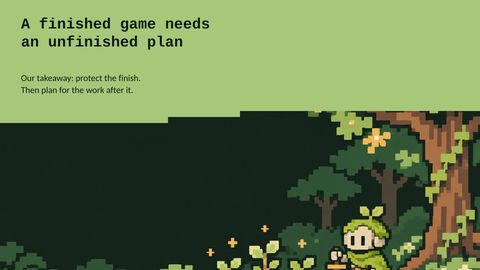
Ines: With that modest surplus, protecting our ability to finish still feels essential—but finishing scope is only half the plan. We also need to decide how we’ll sustain the game once people are actually playing it.
-
8Players liked it; that did not erase the rough edges
Speaker notes
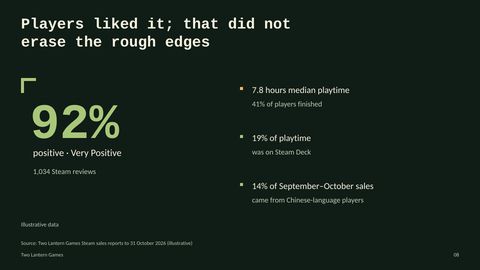
Ines: Sustaining it starts with understanding those players, and their response was encouraging without being a clean bill of health. We had 1,034 Steam reviews with 92% positive, but a median playtime of 7.8 hours sat alongside just 41% finishing according to achievement data; time spent and completion tell us different things. Steam Deck accounted for 19% of playtime, so reliability there mattered beyond the verification badge. Chinese-language players accounted for 14% of September–October sales after Simplified Chinese arrived, which makes that audience important without proving how many extra sales the translation caused.
-
9We built discovery better than we sustained it
Speaker notes
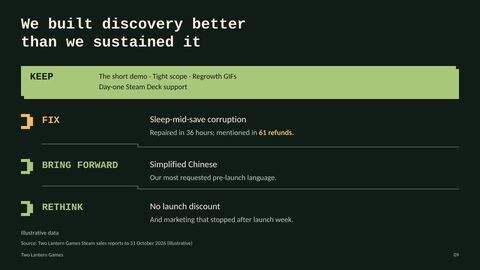
Tom: Those audiences also make our mistakes harder to dismiss, even with strong reviews. We’d keep the short demo, tight scope, regrowth GIFs—which performed better than anything else we posted—and day-one Deck support, but our launch-week sleep-mid-save bug could corrupt saves; we repaired it in 36 hours, and 61 refunds still mentioned it. Simplified Chinese was our most requested pre-launch language, yet we didn’t deliver it until September. We also skipped a launch discount despite reviews telling people to wait for a sale, and stopped marketing after launch week while bug fixing took over. Our discovery work was stronger than our plan for keeping the game reliable, accessible and visible afterward.
-
10Give the months after launch a plan of their own
Speaker notes
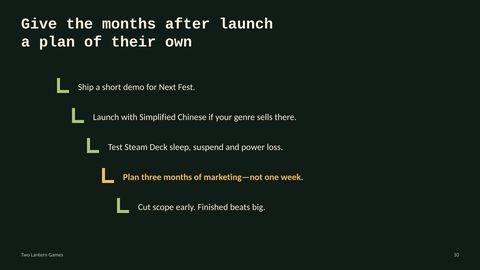
Ines: Turning that diagnosis into decisions, we’d give a short Next Fest demo a clear place in the schedule, because ours delivered the strongest documented wishlist contribution. We’d bring Simplified Chinese forward to launch where there’s a genre audience, rather than leaving a requested language for later. Tom: We’d explicitly test Deck sleep, suspend and power loss, not treat day-one support as the end of the reliability work. We’d also plan three months of marketing rather than one week, so communication doesn’t simply disappear when fixes demand attention. Ines: And we’d cut scope early again—the point is to make room both to finish the game and to look after it.
-
11We’re carrying those lessons into what comes next
Speaker notes
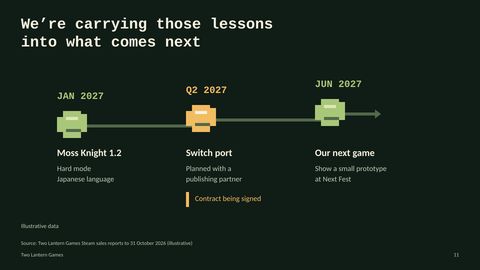
Ines: We’re carrying those decisions into a plan that includes both the existing game and the next one. Moss Knight 1.2 is planned for January 2027 with hard mode and Japanese, followed by a Switch version in Q2 with a publishing partner; that contract is being signed, so this is still a plan, not a completed deal. Tom: Meanwhile, our next game has a small prototype running, which we intend to show at Next Fest in June 2027. The intention is to keep moving without pretending Moss Knight no longer needs us.
-
12Before you launch, plan the months after it
Speaker notes
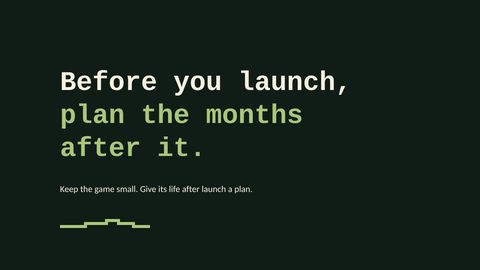
Ines: That’s what we’d ask you to take into your own project: before you commit to a launch, make room for the support, languages and communication that come afterward. Tom: Finishing a small game gave us a chance; planning for its life after launch is what lets us keep making games—thanks for listening.


What you can change in the file
Every word is real text
Titles, bullets and labels are text boxes. Retype them, restyle them or translate them.
Diagrams are shapes
Boxes, arrows and icons are PowerPoint shapes you can move, resize and recolour.
Pictures stay separate
Photos and illustrations are their own images, so you can swap or crop them.
Charts are real charts
Each chart keeps its numbers in its own Excel sheet. Choose Edit Data, type new figures and the chart redraws.
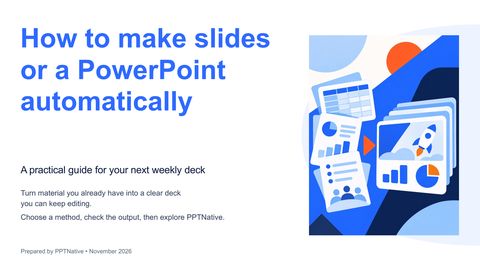 How to make slides or a PowerPoint automatically
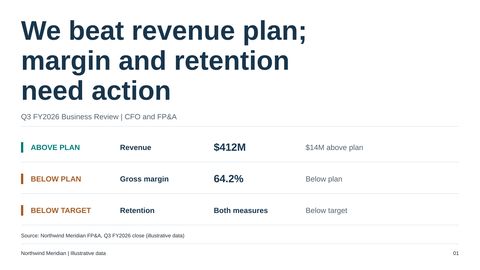 Quarterly business review: performance, drivers and decisions
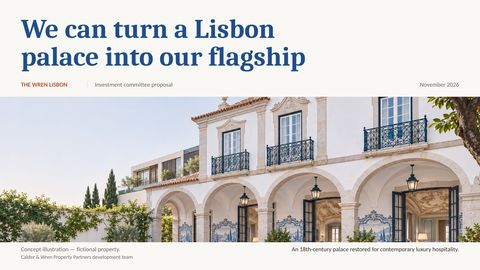 Luxury hospitality: a flagship hotel investment proposal
Make your next deck in minutes, then make it yours.
Start with 20 free credits. No card needed.
Start free