季度经营回顾:业绩、驱动因素与决策
为一家虚构软件公司制作的 14 页高管季度经营回顾,包含七个原生 PowerPoint 图表:收入对比计划、毛利率桥、区域表现、留存率对比目标、流失原因和第四季度展望。下个季度打开“编辑数据”,输入新数字,所有图表都会重新绘制。演示数据。
一份两页的虚构简报(Markdown),来自公司财务计划与分析团队:分季度和区域的收入与计划、毛利率驱动因素、留存率及目标、流失原因、第四季度预测、上季度承诺、带责任人的优先事项和待决事项。按本系列统一风格绘制,风格取自“集团 AI 转型”那份演示。
以及这些说明The company's own quarterly business review, presented by the CFO and FP&A team to the executive leadership team: write in the presenters' voice, stating results, causes and asks with confidence, not as an outside reviewer questioning the brief. Cover revenue versus plan, last quarter's commitments, margin drivers, regional performance, customer retention, the Q4 outlook and next-quarter priorities with owners, ending with the decisions requested. Show every series of numbers as a native, editable chart (revenue versus plan, regional actual versus plan, the margin bridge, the retention trend against target), so the team can update the deck with new data each quarter. All figures are fictional: label them Illustrative data, and write source lines as 'Source: Northwind Meridian FP&A, Q3 FY2026 close (illustrative data)', never 'the brief'. Speaker notes should interpret each chart and give the talking points.
免费下载,无需登录。用 PowerPoint 打开即可随意修改。

- 风格
- 瑞士极简自动选择
- PPT 类型
- 经营回顾
- 图片
- 不用图片
- 幻灯片
- 14
- PPT 语言
- English
每一页,未经修改
点击幻灯片查看大图。
-
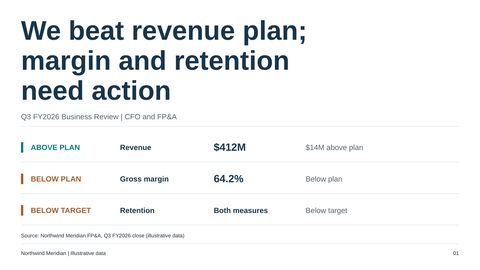
1We beat revenue plan; margin and retention need action
演讲者备注
Today, we’ll review a quarter in which revenue exceeded plan, but the underlying operating performance was less strong. We finished at $412 million in revenue, while gross margin and both retention measures fell below expectations. Our focus is on what drove that divergence, what it means for Q4, and the targeted decisions we need from this team.
-
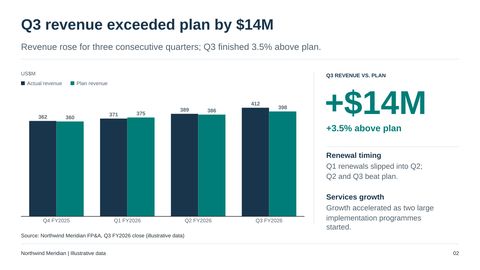
2Q3 revenue exceeded plan by $14M
演讲者备注
Starting with the revenue strength, Q3 finished $14 million above the $398 million plan, a 3.5% beat. Revenue has increased for three consecutive quarters, although renewal timing affected performance against plan: enterprise renewals that slipped out of Q1 helped Q2. Services also accelerated as two large implementation programs started, increasing their share of revenue from 21% in Q2 to 23% in Q3. That mix shift matters as we turn from growth to profitability.
-
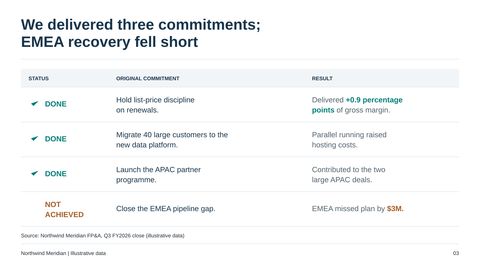
3We delivered three commitments; EMEA recovery fell short
演讲者备注
Behind that revenue result, we delivered three of the four commitments made at the Q2 review, but completion did not always translate into immediate operating improvement. Renewal pricing discipline added 0.9 percentage points to gross margin, and the APAC partner launch contributed to the two large deals there. We also migrated all 40 large customers, but running the old and new environments in parallel raised hosting costs. The unresolved commitment was EMEA pipeline recovery, where revenue still missed plan by $3 million.
-
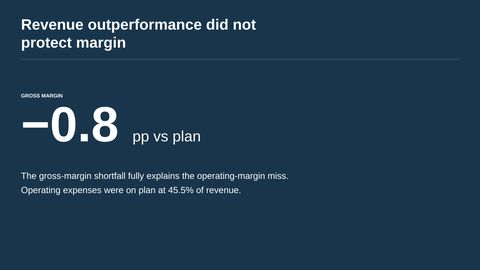
4Revenue outperformance did not protect margin
演讲者备注
Those execution outcomes help explain why the revenue beat did not carry through to operating margin. Operating margin was 18.7% against a 19.5% plan; with operating expenses on plan at 45.5% of revenue, the entire gap came from gross margin.
-
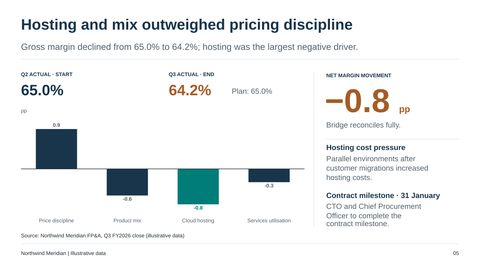
5Hosting and mix outweighed pricing discipline
演讲者备注
Within gross margin, hosting was the largest negative driver, but it was not the only pressure. Pricing discipline added 0.9 points, while the greater services mix cost 0.6 points, hosting cost 0.8 points, and services utilization cost another 0.3 points. Together, those movements reconcile the decline from 65.0% in Q2 to 64.2% in Q3, also 0.8 points below plan. The hosting issue is tied to parallel environments following migration, so completing the customer moves alone was not enough; decommissioning and the contract work must follow.
-
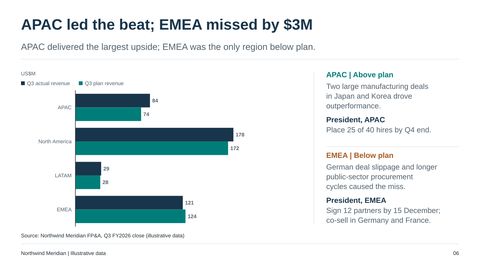
6APAC led the beat; EMEA missed by $3M
演讲者备注
Turning from the cost drivers to where growth came from, regional performance was uneven. APAC delivered $84 million against a $74 million plan, the largest positive variance, driven by two manufacturing deals in Japan and Korea. EMEA delivered $121 million against $124 million, with German deal slippage and longer public-sector procurement cycles causing the shortfall. The response is therefore different by region: add capacity to support APAC demand, while building partner co-selling coverage in Germany and France.
-
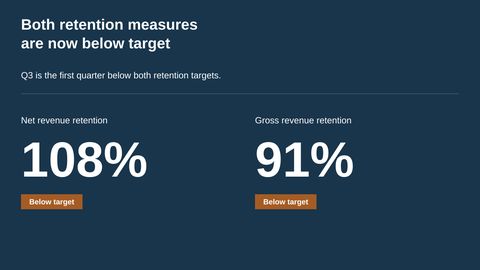
7Both retention measures are now below target
演讲者备注
Beyond those regional differences, retention is a separate operating weakness that the revenue beat must not obscure. Q3 was the first quarter in this period with both measures below target, so we need to address both expansion performance and losses within the existing customer base.
-
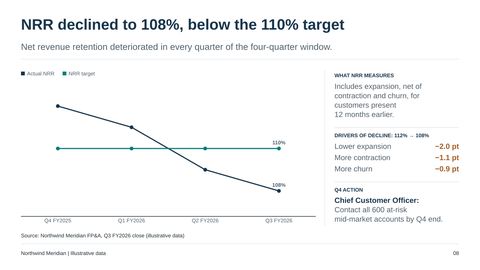
8NRR declined to 108%, below the 110% target
演讲者备注
Looking first at retention including expansion, NRR declined every quarter from 112% to 108%, versus a 110% target. This measure follows customers who were with us 12 months earlier, capturing expansion as well as contraction and churn. Half of the four-point decline came from lower expansion, specifically fewer mid-market upsells; the other half came from increased contraction and churn. That means the issue is broader than customer departures alone, and the Chief Customer Officer’s Q4 action is to contact all 600 at-risk mid-market accounts.
-
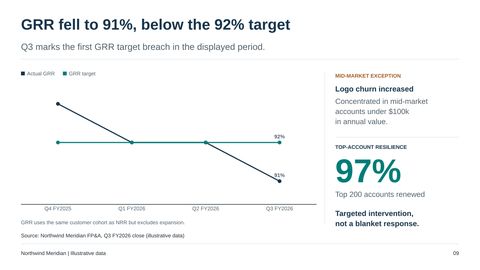
9GRR fell to 91%, below the 92% target
演讲者备注
Excluding expansion confirms that the deterioration is not just an upsell issue. GRR fell from 93% to 91% across the period, breaching the 92% target for the first time in Q3. Logo churn rose to 1.9% from 1.6% in Q2 and was concentrated in mid-market accounts with annual value under $100,000. By contrast, the top 200 accounts, representing 58% of subscription revenue, renewed at 97%, supporting a targeted intervention rather than a blanket response.
-
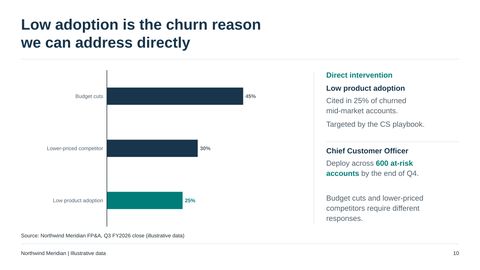
10Low adoption is the churn reason we can address directly
演讲者备注
That concentration tells us where to intervene, while exit interviews help define what the intervention can realistically address. Low adoption was cited by 25% of churned mid-market accounts, compared with 45% citing budget cuts and 30% citing lower-priced competitors. The customer-success playbook directly targets adoption across the 600 at-risk accounts by Q4 end. We should not treat it as a solution to every churn cause; budget pressure and competitive pricing require different responses.
-
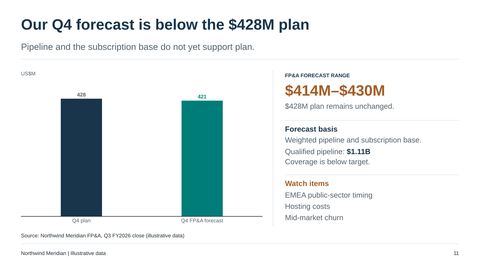
11Our Q4 forecast is below the $428M plan
演讲者备注
These retention pressures, together with the pipeline position, inform a Q4 forecast that remains below plan. FP&A forecasts $421 million against the unchanged $428 million plan, with a range of $414 million to $430 million. The $1.11 billion qualified pipeline provides 2.6 times coverage against a target of 3.0 times, so the weighted pipeline and subscription base do not yet support plan. About $9 million of pipeline is exposed to EMEA public-sector timing, while mid-market churn remains a revenue risk and hosting costs remain a margin risk.
-
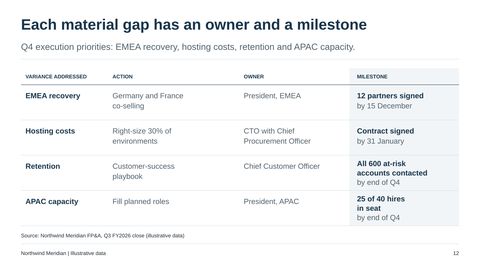
12Each material gap has an owner and a milestone
演讲者备注
Against that outlook, execution needs to be tied to named owners and measurable milestones. The President of EMEA owns signing 12 partners by December 15 to support co-selling in Germany and France. The CTO and Chief Procurement Officer own the hosting program, including right-sizing 30% of environments and signing the contract by January 31. The Chief Customer Officer owns contacting all 600 at-risk accounts by Q4 end, while the President of APAC owns placing 25 of the planned 40 hires by the same point. These milestones let us distinguish progress on the actions from the financial outcomes we still need to deliver.
-
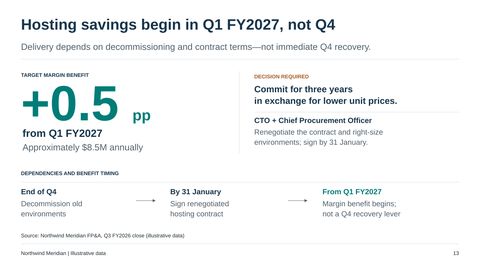
13Hosting savings begin in Q1 FY2027, not Q4
演讲者备注
One timing distinction is especially important within that execution plan: hosting is not a Q4 margin recovery lever. The targeted benefit is 0.5 percentage points of margin, approximately $8.5 million annually, beginning in Q1 FY2027. It depends on decommissioning old environments by Q4 end and signing the renegotiated contract by January 31. The decision is whether to accept a three-year commitment in exchange for lower unit prices, with the CTO and Chief Procurement Officer accountable for delivery.
-
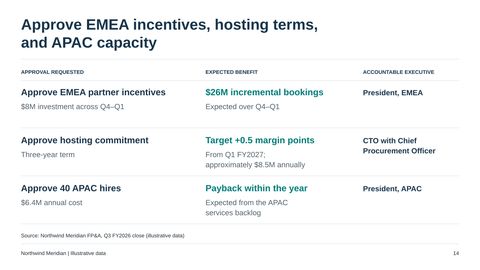
14Approve EMEA incentives, hosting terms, and APAC capacity
演讲者备注
With that benefit timing clear, we’re asking for three targeted approvals. First, approve $8 million of EMEA partner incentives across Q4 and Q1, with expected incremental bookings of $26 million over that period under the President of EMEA. Second, approve the three-year hosting commitment, targeting the margin benefit from Q1 FY2027 under the CTO and Chief Procurement Officer. Third, approve 40 APAC hires at an annual fully loaded cost of $6.4 million, with payback expected within the year from the services backlog under the President of APAC. These decisions support recovery and capacity where the evidence points, while the owned milestones keep us accountable for execution rather than assuming the Q3 revenue beat has resolved the operating gaps.


文件里可以修改什么
每个字都是真实文字
标题、要点和标签都是文本框,可以改写、换样式或翻译。
图示都是形状
方框、箭头和图标都是 PowerPoint 形状,可以移动、缩放和改颜色。
图片各自独立
照片和插画都是单独的图片,可以替换或裁剪。
图表是真正的图表
每个图表的数据都保存在自己的 Excel 表里。选择“编辑数据”,输入新数字,图表就会重新绘制。
改一下数字,图表随之更新
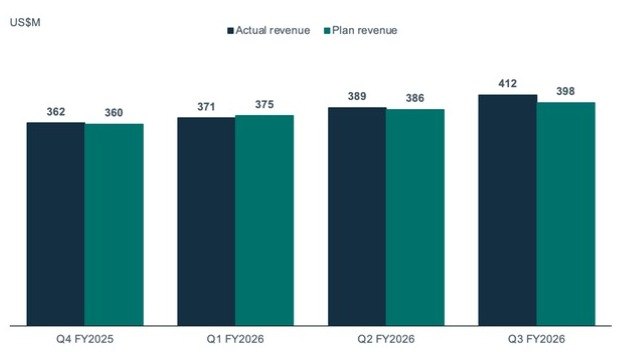
1PowerPoint 里的原生图表:第三季度实际收入为 412。
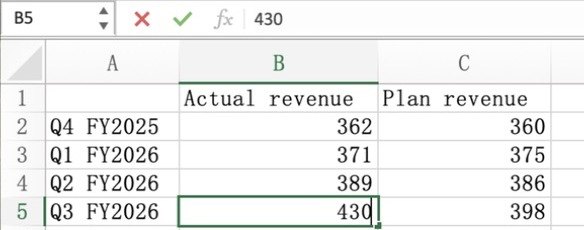
2图表设计 › 在 Excel 中编辑数据,打开图表自己的数据表。把第三季度改成 430。
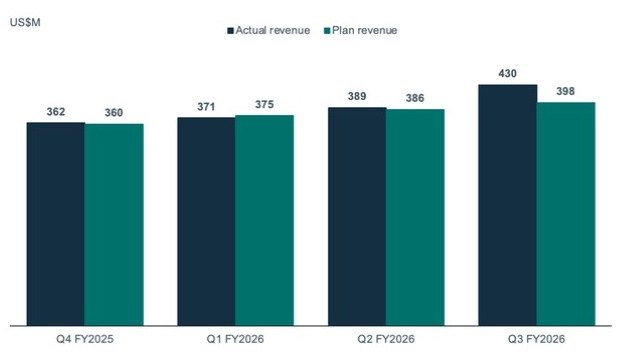
3回到 PowerPoint,柱形和数据标签已经重新绘制。
 如何自动制作幻灯片或 PowerPoint
 高端酒店:旗舰物业投资提案
 AlphaFold 3:面向生物医药研发负责人的研究简报